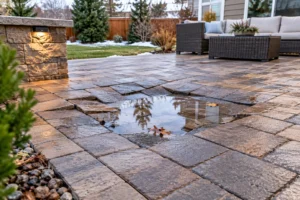

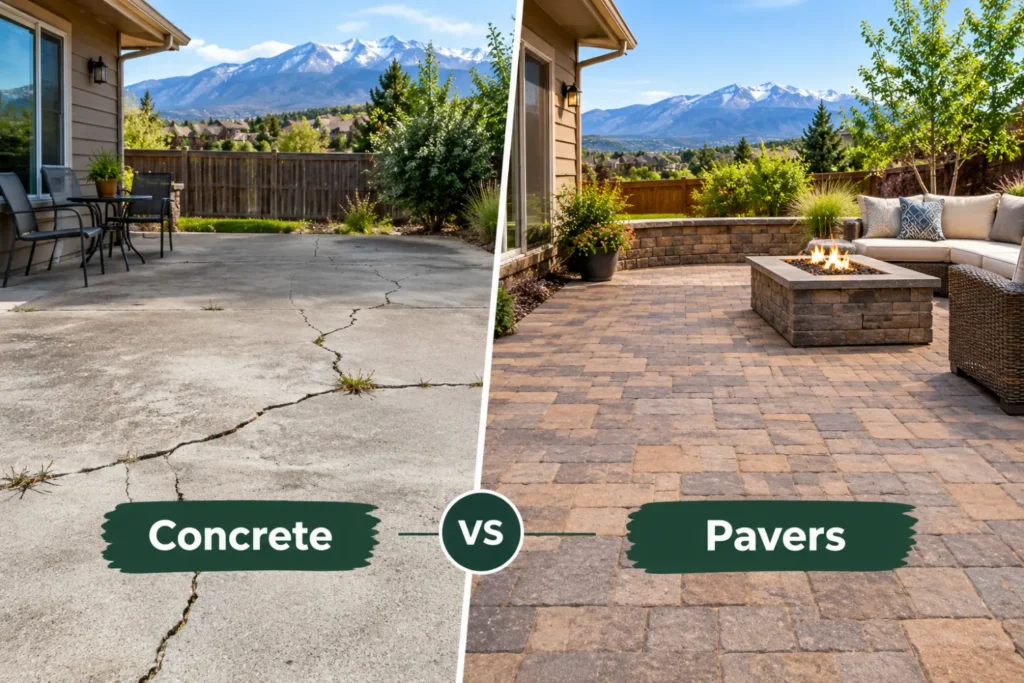
In Colorado, pavers are usually the better long-term choice. Concrete costs less up front (about $10 to $16 per square foot for a plain slab in Denver vs. $18 to $35 for pavers), but our freeze-thaw winters, clay soil and de-icing salts make concrete crack. Pavers flex with ground movement and can be repaired one piece at a time. Concrete still makes sense for simple, budget-focused projects.
If you’re choosing between a concrete patio and pavers, you’re really choosing between two different ways of handling Colorado’s weather. This guide compares cost, durability, maintenance and looks so you can decide which one fits your yard and budget.
Pavers vs Concrete Patio: At a Glance
| Factor | Pavers | Poured concrete |
|---|---|---|
| Installed cost (Denver) | $18 to $35 per sq ft | $10 to $16 plain; $16 to $28 stamped |
| Cracking | Joints let pavers move without cracking | Cracks are very likely over time |
| Freeze-thaw performance | Excellent | Fair; prone to cracking and surface flaking |
| Repairs | Lift and reset individual pavers | Patches show; large damage means replacement |
| Strength | Typically 8,000+ psi per paver | Typically 3,000 to 4,500 psi |
| Ready to use | Same day | About a week for foot traffic; 28 days to fully cure |
| Design options | Many colors, shapes, patterns | Limited; stamped adds patterns |
| Lifespan (with good install) | 25 to 50 years | 15 to 30 years |
Cost of Concrete Patio vs Pavers
Concrete wins on day-one price. Here’s what Denver homeowners typically pay for a 400 square foot (20×20) patio:
| Patio type | Cost per sq ft | 20×20 patio (400 sq ft) |
|---|---|---|
| Plain broom-finish concrete | $10 to $16 | $4,000 to $6,400 |
| Stamped concrete | $16 to $28 | $6,400 to $11,200 |
| Concrete pavers | $18 to $35 | $7,200 to $14,000 |
But the upfront price isn’t the full story. Concrete costs more to maintain and repair over time:
- Stamped concrete needs resealing every 2 to 3 years, at roughly $1.50 to $3 per square foot.
- Cracked slabs can’t be patched invisibly. Major cracking or heaving usually means tearing out and replacing the whole section.
- Pavers usually need only occasional joint sand top-ups. If a section settles, it can be reset with the same pavers.
Over 20 years, the gap between the two often shrinks or disappears. For a full breakdown of paver pricing by size and material, see our paver patio cost guide for Denver.
Durability in Colorado’s Climate
Colorado is tough on outdoor surfaces. Three things make the biggest difference for patios here.
Freeze-thaw cycles
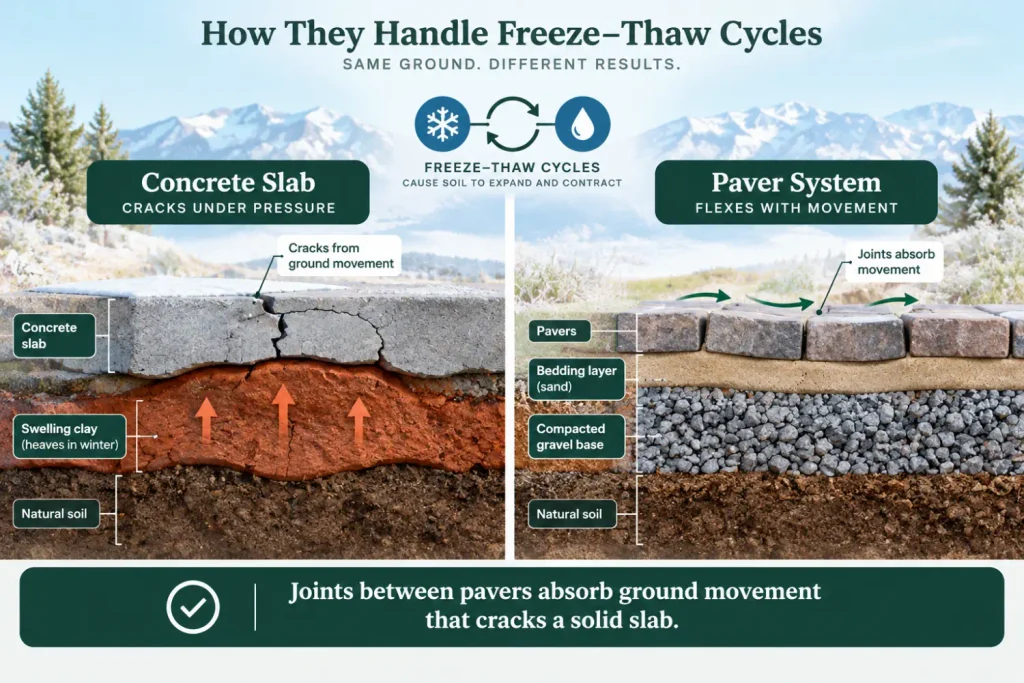
Denver can swing above and below freezing many times in a single week. Water seeps into tiny pores and cracks, freezes, expands and widens them. A concrete slab is one rigid piece, so that pressure turns into cracks. Pavers are individual units with joints between them, so the surface can shift slightly without breaking.
Expansive clay soil
Much of the Front Range sits on clay soil that swells when wet and shrinks when dry. That movement lifts and drops a rigid slab unevenly. A paver patio built on a deep, compacted gravel base handles this movement far better.
De-icing salt and snow
Ice melt can cause concrete’s surface to flake and pit, a problem called spalling, especially on newer concrete. High-density pavers resist salt damage better. If one does get damaged, you can replace that single paver.
Are Pavers Better Than Concrete?
For most Colorado homeowners, yes. Pavers are stronger per piece, handle freeze-thaw better, look better as they age and are far easier to repair. The trade-off is a higher upfront cost and the need to keep joint sand topped up.
Pavers are the better choice if you:
- Plan to stay in your home for many years
- Want a high-end look with patterns, borders or curves
- Have clay soil or drainage issues
- Want to avoid visible cracks and costly slab replacement
- Plan to add a fire pit, seat walls or an outdoor kitchen
Concrete can make sense if you:
- Need the lowest possible upfront cost
- Want a simple, flat, functional surface (like a side yard or utility pad)
- Are preparing a home for a quick sale
Stamped Concrete Patio vs Pavers
Stamped concrete is poured concrete pressed with patterns and color to look like stone, brick or pavers. It’s a popular middle ground, but in Colorado it shares the same weaknesses as plain concrete.
- Cost: Stamped concrete ($16 to $28 per sq ft) can cost nearly as much as pavers.
- Cracking: It still cracks, and cracks are more noticeable because they cut across the pattern.
- Maintenance: It needs resealing every 2 to 3 years to protect the color and surface.
- Repairs: Matching the color and pattern on a repair is very difficult.
- Slipperiness: Sealed stamped concrete can get slick when wet or icy. Pavers have more natural texture.
If you’re drawn to the look of stamped concrete, real pavers usually deliver the same style with better long-term performance for a small difference in price.
Maintenance Compared
Paver maintenance
- Sweep and rinse as needed
- Top up polymeric joint sand every few years
- Optional sealing every 3 to 5 years to enhance color
- Reset any pavers that settle
Concrete maintenance
- Seal regularly (especially stamped concrete)
- Fill cracks to keep water out
- Avoid de-icers, especially in the first winter
- Replace sections when cracking or heaving gets severe
One maintenance note for pavers: if a section sinks, it’s usually a base or drainage issue that can be fixed. Our guide on how to fix sunken pavers walks through the process.
Appearance and Design Options
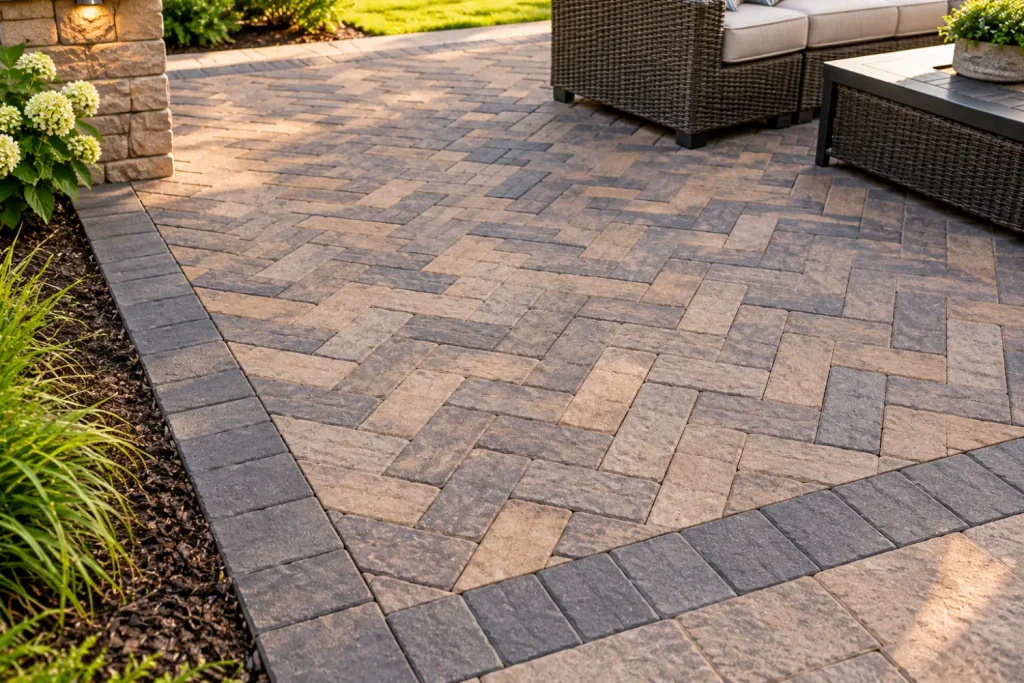
Pavers come in dozens of colors, textures and shapes, from classic brick to large-format modern slabs. You can mix sizes, add borders, create inlays and lay patterns like herringbone or basketweave. Because the color runs through each paver, it fades slowly and evenly.
Concrete is mostly a blank slate. Stamping and staining add options, but surface color can wear in high-traffic spots and under Colorado’s strong sun.
Installation Time
A paver patio is usable the day it’s finished. There’s no curing time, so you can put furniture out right away.
Concrete needs time to cure. Light foot traffic is usually fine after a few days, but it’s best to wait about a week before placing heavy furniture, and the slab takes roughly 28 days to reach full strength. Pouring is also weather-dependent, which matters during Colorado’s unpredictable spring and fall.
Resale Value
Both add value by creating usable outdoor space. Pavers tend to be seen as a premium upgrade, while a cracked concrete patio can become a negative during a home inspection. In a competitive market like Denver, a well-kept paver patio helps a backyard stand out.
Frequently Asked Questions
No, not up front. In Denver, plain concrete runs about $10 to $16 per square foot and pavers run $18 to $35. Pavers often cost less over time because they rarely need full replacement.
Yes, when installed on a proper base. A well-built paver patio can last 25 to 50 years, while concrete patios in Colorado typically last 15 to 30 years before cracking becomes a problem.
Slightly. Stamped concrete costs about $16 to $28 per square foot in Denver, close to the low end of paver pricing. It also needs regular resealing and can crack.
Sometimes. If the slab is level, stable and drains well, thin pavers can be installed over it. If it’s cracked, heaving or sloped toward the house, it’s better to remove it and build a proper base.
Sealing is optional. It can enhance color and help resist stains, but quality pavers perform well without it.
Talk to a Denver Patio Expert
Still deciding? We can look at your yard, soil and drainage and give you an honest recommendation. Ridgewell Landscape and Design installs paver patios throughout Denver and the Greater Denver Metro, and every paver installation comes with a 5-year paver warranty.
Learn more about our paver patio installation services or book your free consultation.